Near Lightning-Strikes and Damage at KA1-RBP
R.Kwas KA1-RBP 12/2015
Grounding System at the
KA1-RBP QTH
Frankenstein Memorial Knife Switch
I have mixed feelings for lightning...it puts on an awesome lightshow which I enjoy being impressed by when I am watching from a safe place...on the other hand, I know how much energy is in each bolt, and so much uncontrolled high energy is just looking to fry something electrical. One should certainly have a healthy respect for lightning...Radio Amateurs, with antennas in the sky over their house, maybe even a bit more!
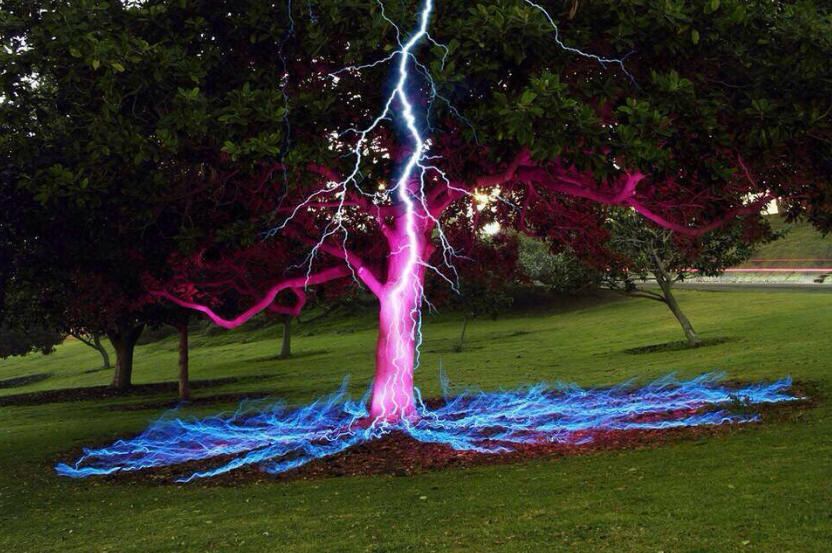
This is probably photoshopped, but is still a good representation of what happens, and therefore a good demonstration of why NOT TO SEEK OUT TREES DURING ELECTRICAL STORMS!
An Advantageous Geographical Location? Being located about 2 miles on the lee-side of the Avon Mountain Ridge on the west side of the Connecticut River Valley, I believe the KA1-RBP geographic location is mildly advantageous under a Local High Pressure area just ahead of what I call the "Ridge-Vortex". The Local High Pressure zone that occurs, is due to the Ridge at Avon Mountain, redirecting the prevailing wind and weather systems coming from the West, upwards. Many a time have I seen mean looking weather systems coming in from the West, to see them be lifted over our location, without local action, only to see them touchdown again to our East with meteorological ferocity. It's not that I've been particularly good or that I've eaten my vegetables, that I'm spared a pounding by the weather...I believe this can be explained by our location under the Local High Pressure area...that's not to say that we are always spared severe weather, but more often than not, it seems to fly over us and touch down once again to rain on or seriously pound the area just to our East.
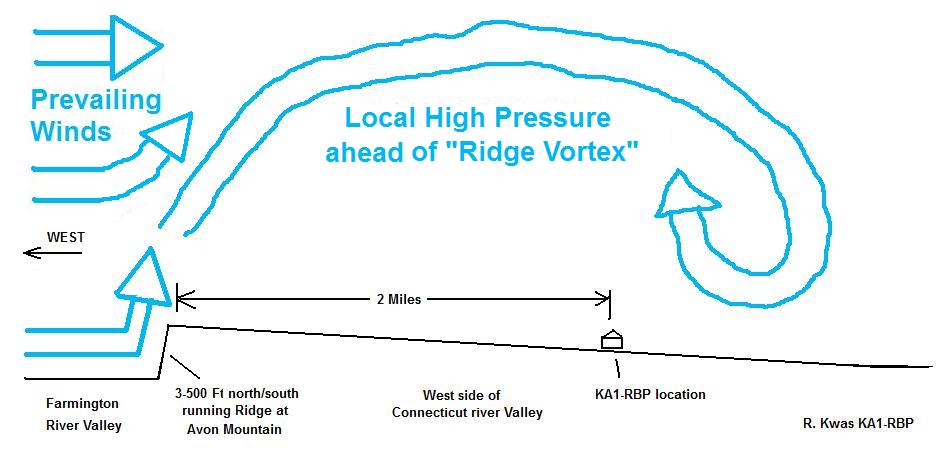
Of course, the altitude of the Local High Pressure area and point where Ridge Vortex touches back down and dissipates are fairly variable as a function of several factors (mostly I expect the speed at which the Prevailing Winds are moving), so we are not completely spared by the weather...and having anything less than an excellent grounding system at a QTH is not an option anyway. That is why I still believe in a Comprehensive Grounding System at the KA1-RBP QTH. Twice, we have had Near-Lightning-Strikes (never a Direct-Strike!), but both times we have been fairly lucky with only what I consider minor damage...maybe the QTH grounding system didn't help, but I expect it did.
Near-Lightning-Strike One:
A long time ago, when Nick was about "three cheeses tall", and printers took more than 5 minutes to produce an 8 1/2 x 11 full-color print, Wendy had just started printing such an output, even though I could see serious weather bearing down on us through the kitchen window to the West, and I had warned her to secure computer operations. Nick and I were standing in the kitchen when a bright flash and instantaneous REPORT, caused us both to nearly soil ourselves, and the breaker for the office to trip, abruptly halting all goings-on in there.
The short which caused the breaker was still present when I tried to reset the breaker. It turned out to be one of the extra 120V Tranzorbs (1.5KE220CA Ref: http://www.vishay.com/docs/88301/15ke.pdf ), surplussed from a previous employer, and which I had added to the power strip which all the computer equipment was plugged into. (Tranzorbs were connected: Hot - Neutral, Hot - Ground, even Neutral - Ground...you never know where current will flow when "Lightning Hits"! It was the Hot - Neutral connected one that "got it".). Thus protected, all the computer equipment did survive undamaged, so I would say the Tranzorb did its job well...the 8 1/2" X 11" print however, needed to be restarted!
Near-Lightning-Strike Two:
Another summertime Lightning Storm had again flown-over our location (I maintain, thanks to the Local High Pressure area!)...this time without actually dropping any rain on the QTH. We had remained inside as it passed us over, with many impressive boomers from Cloud-to-Cloud discharges, and it was actually calming down already at our location, so Nick and I went outside the front door watching the Lightning Strikes downrange, when the Near-Strike hit, like those very last BOOMs at the 4th of July fireworks shows, which they like to surprise onlookers with...it sure as hell had that effect! A bright flash and instantaneous deafening report got both of our attentions!!! I decided on the spot that I'd had enough Lightning watching for one day and headed inside...only to have Wendy running towards me from the office, jumping into my arms crying "SAVE ME!...SAVE ME!".
I estimate the Strike hit a tree on the property somewhere behind the house...the Flash and Explosion must have been even more intense out the office room window, so she had a good surprise.
As far as damage goes, I believe it was only an induced Surge on Ethernet cable (from our own private Electro-Magnetic Pulse [EMP] which had occurred) that took out an Ethernet card, a router, and a DVR...minor damage really, considering what all could have been taken out with a direct hit!
------------------------------
Points of Note:
SAFE Antenna Condition: Whenever I'm not on the air, and certainly
whenever I leave the house or bad weather is in the area, as well as switching
the FMKS to the SAFE position (something I can do, and have
done in my jammies),
I also disconnect the Feedline from the input outside the house, and clip it to the Chain Link Fence
(something I need to go outside for, but what I have also done in my jammies!). I suppose I could
just
leave the Feedline connected and simply transfer the FMKS...then again, I don't
want the wire that might take a direct hit, even attached to the house!!
What I know of Water and Lightning.
I don't know much, but I know water likes to run downhill...as a corollary to
that, Lightning also likes to "run downhill"...to ground, and if we don't give
it an easy path, it will find (or make) its' own...and if that happens to be by
way of the toaster-oven or stereo, it doesn't much care one way or another!!
All Lightning Handling Conductors have a Minimum Bend Radii of 6". We wouldn't want Saint Elmo's fire hopping off the end of a sharp bend due to charge accumulation!
------------------------------
Comprehensive Grounding System at the KA1-RBP QTH: Under the philosophy - A QTH only has enough ground paths when it is a Faraday Cage!, I have added a few...shown on diagram below.
Electrical Service: Typical original grounding per Electrical Code by way of the "Cold Water Pipe" is augmented with an additional 8Ft. Ground Rod at the Service Entrance (Location 0).
Telephone Service: Grounded to wire running to "Cold Water Pipe" at the Electrical Service Entrance using phone companies standard grounding block fixtures with carbon blocks.
Cable Television Service: Grounded to Grounding Rod (Location 0) the Electrical Service Entrance by way of their standard grounding block. Distribution Amp in cellar is also directly grounded to cold water pipe.
KA1-RBP Station Additional Grounding: I have added multiple 8Ft. Ground Rods into the moist and conductive W. Harford clay around the QTH! Specifically right outside the Frankenstein Memorial Knife Switch (FMKS), (Location 1), Monopole Base (Loc. 2), North-West corner (Loc. 3), and North-East Corner (Loc. 4). Locations 0, 1, 2, and 3 are also tied together by way of 12ga. copper conductor as well as the Chain-Link Fence posts on the West side under the principle of NO POTENTIAL DIFFERENCES between "grounds"!.
Additional Air Terminals are located at the Roof North-West and North-East peaks, and tied to the location 3 and 4 Ground Rods respectively.
Operating Position: All shack equipment, including base of Big Kahuna Tuna is tied together by way of a 1" braid which also runs to the Location 1 Ground Rod.
The Alpenshack is situated amongst (and much lower than the canopies of) the trees, and has its own Air Terminal and Ground Rod (Loc. 5), as well as connection to Chain Link Fence.

Comprehensive Grounding System at the KA1-RBP QTH
------------------------------
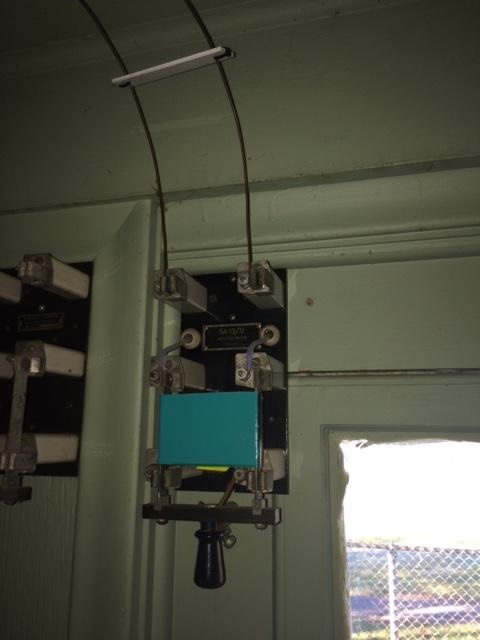
Frankenstein Memorial Knife Switch (FMKS) is one of those beefy Navy surplus shipboard knife switches (...throw the switch Igor!...yes master!). It has a 3" spacing of the two conductors so represents (I expect) a negligible impedance discontinuity to the homemade 3" open line. The two transfer contacts are tied together by an insulator with a handle for ease of transferring, and the grounded connection is by way of an 8ga. solid copper conductor out to the nearest Ground-Rod (Loc. 1), continuing on to the rest of the grounding system. I've added color coded panels for instant visual recognition of switch condition: Up/Red-Yellow = On-Line and OPERATING OR Down/Green = Grounded and SAFE. The contacts on ceramic pedestals look like they would be loafing while handling hundreds of Amps...I like that!
Pictures of the FMKS:
 |
 |
|
OPERATING position of FMKS. Transfer contacts connect shack to two 12ga. wires in Teflon tubing and routed out ceramic tubes, where the antenna feedline is clipped on with heavy duty crocodile clips. A Spare FMKS is visible on the left, above, one of the standard 3" PVC feedline spacers can be seen, and chain link fence is also visible throught the window. |
SAFE
position of FMKS. Feedline is
connected to lower two contacts, which are tied together by way of an 8ga copper conductor, and routed out a ceramic tube to run to Grounding Rod (Location 1). That is, IF Feedline is connected at all...double SAFE condition of KA1-RBP is Feedline disconnected and clipped to the Chain Link Fence! |
------------------------------
External material sources are attributed. Otherwise, this article is Copyright © 2015. Ronald Kwas, KA1-RBP. The information presented comes from my own experience and carefully considered opinion, and can be used (or not!), or ridiculed and laughed at, at the readers discretion.
You are welcome to use the information here in good health, and for your own non-commercial purposes, but if you reprint or otherwise republish this article or diagrams, you must give credit to the author and to this site as the source. If you don’t, you’re just a lazy, scum sucking plagiarist, and the Boston Globe wants you! As always, if you can supply corrections, or additional objective information or experience, I will always consider it, and consider working it into the next revision of this article...along with likely the odd metaphor and probably wise-a** comment.